
abalone / ZÈRTZ
Ball Abstracts from A to Z

There is a purity in an abstract game.
No theme. Often no luck. It’s not about anything. It’s a game, a mental test.
Personally, I find them dry. But not everything appeals to everyone. Still, enough people share my general dislike for abstracts (excepting classics like Chess) that I never would have suspected that an abstract game about pushing balls around would become a monster hit; or that another abstract game about moving balls around would become a quiet sleeper hit.
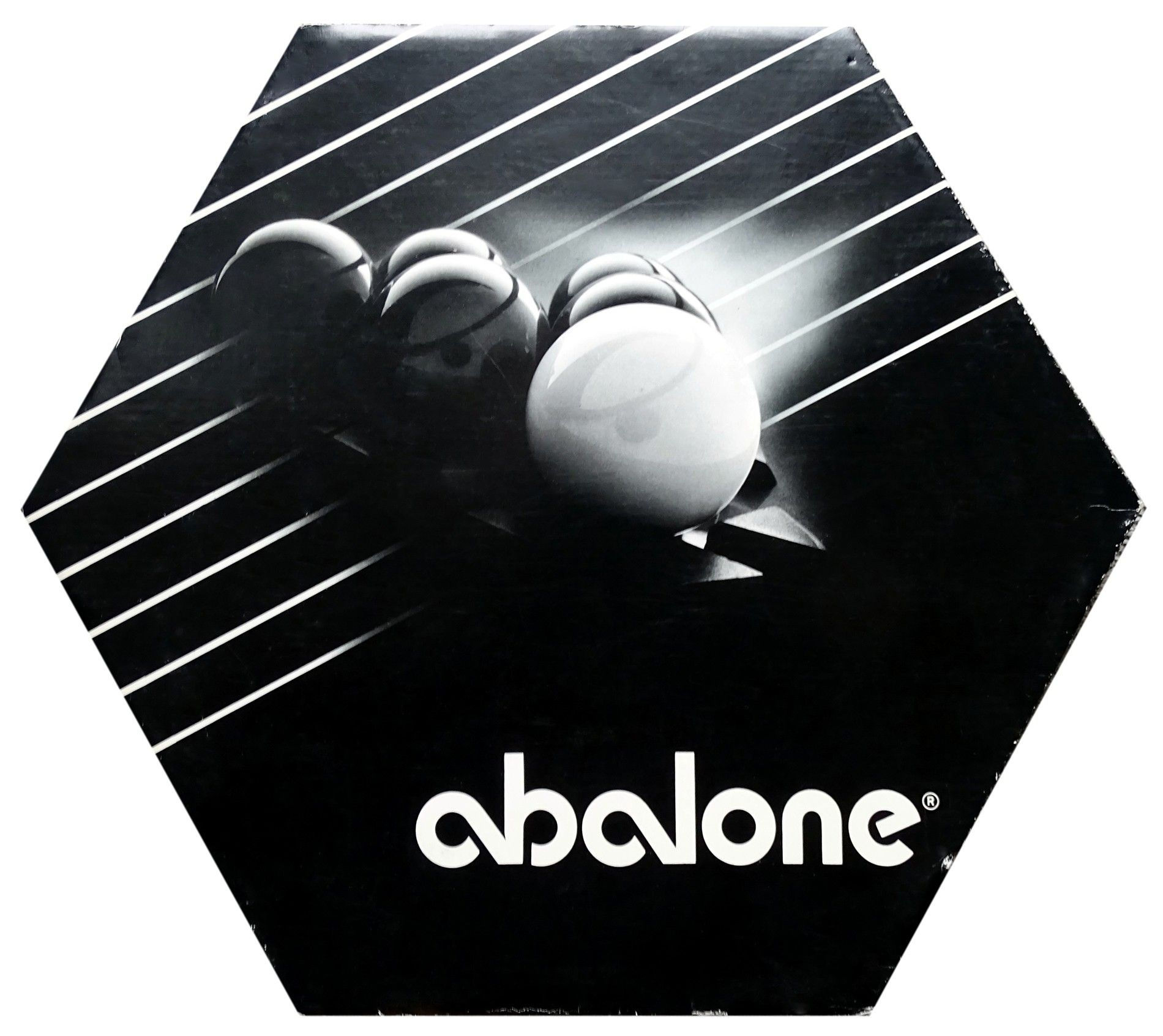
Michel Levant and Laurent Levi’s Abalone is a stunningly beautiful game. It’s simply gorgeous, a minimalist design that invites you to play with it. The 13 white balls and 13 black balls sit in in and on a hex grid where you can shove one ball forward, perhaps pushing an entire line of balls. But you need to have more balls lined up than your opponent. Three balls can push two, but not vice versa.
The goal is to be the first to knock off six balls of your opponent’s color.
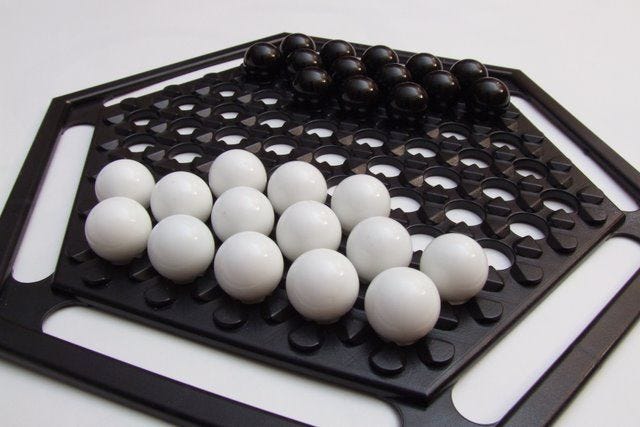
Just as there are coffee table books, Abalone looked great set up and could function as a display piece. As an abstract game, it has a flaw (common to a fair number of games) that defending is better/easier than attacking. The best play might be to build a huge glob and shuffle back and forth, waiting for your opponent to make a mistake. As noted on Wikipedia “ ….serious Abalone players tacitly agree to play aggressively.”
But obviously this flaw was not a deal breaker, as Abalone sold over 4.5 million copies!
Abstract games are … abstract. Any links between them are ones that we find. Sometimes tenuous; but sometimes they jump out.
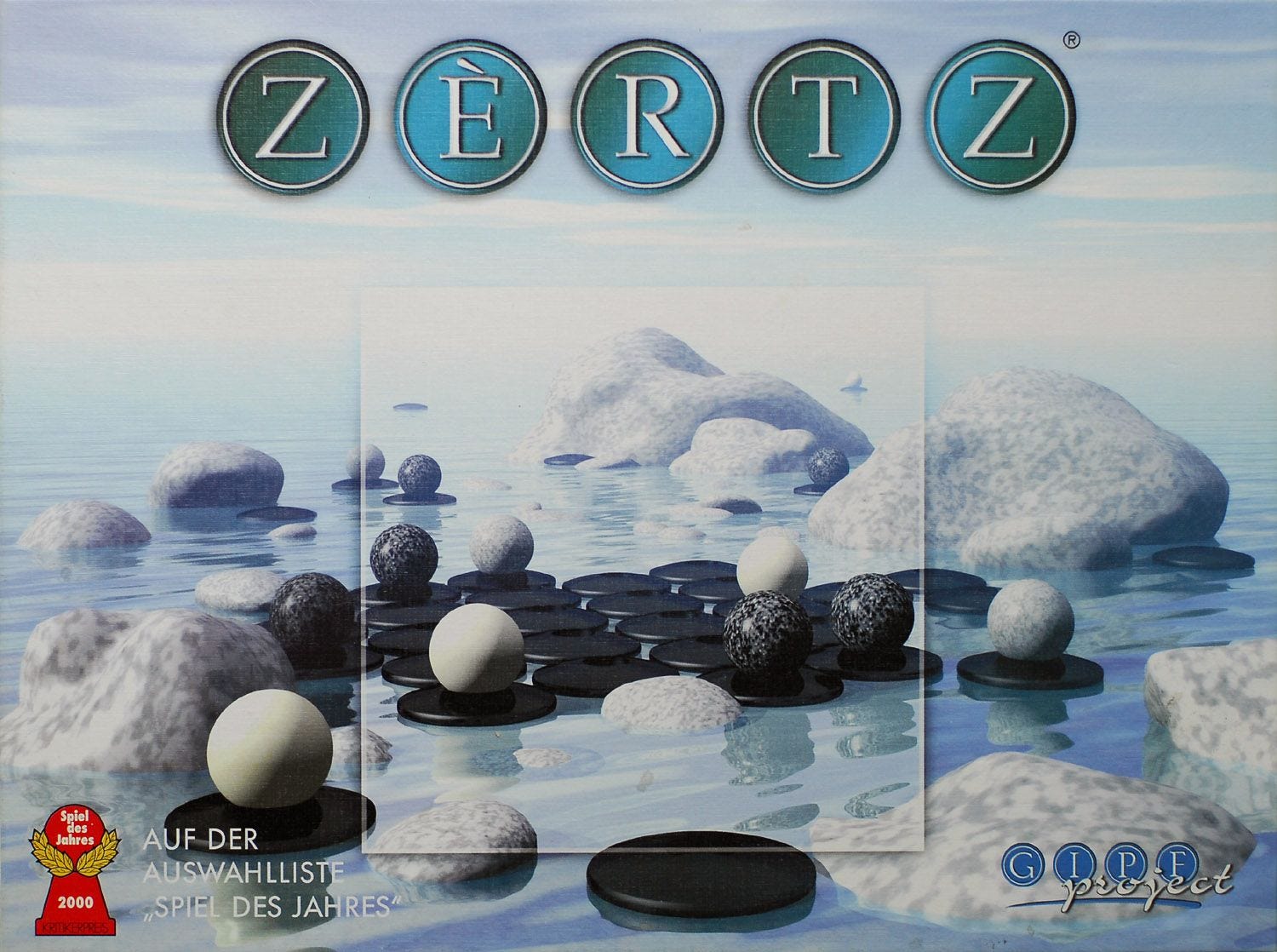
Kris Burm’s ZÈRTZ could be the anti-Abolone.
Opposite ends of the alphabet. Abalone is capitalized normally online, but look at that box … it says ‘abalone’ in all-lower case. ZÈRTZ is all-caps.
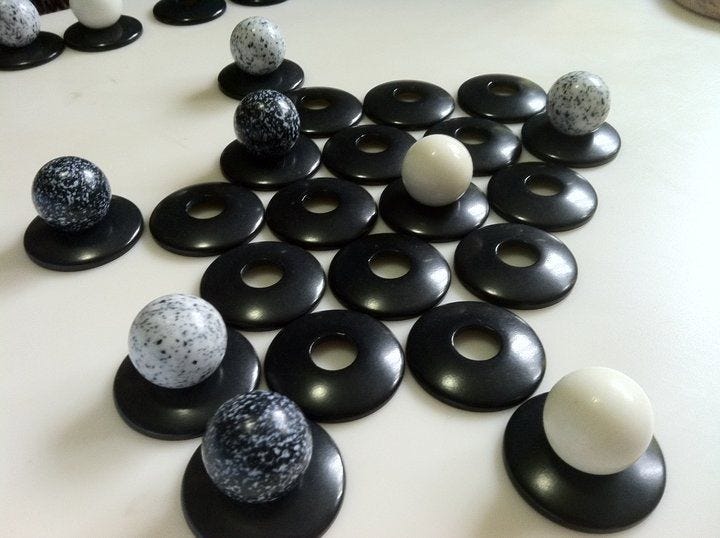
And the gameplay — In ZÈRTZ you don’t control a color. Each turn you either add a ball to the board (a series of simple black ring stands, built in a near hexagon) or capture by jumping balls, like checkers. Also like checkers, you must capture if you can. The first player to capture a majority of a single color wins, or the first player to get three of each color.1 There are a few more rules2, but that’s it.
One similarity — ZÈRTZ looks amazing.
ZÈRTZ was very well received in the game community, because it also did not suffer from abalone’s flaws. Because the board shrinks, the game will eventually end, and because capturing is forced flashy sacrifices are the rule of the day. ZÈRTZ won the prestigious Spiel des Jahres award in 2000. (Update — Somehow I misread & misremembered that. Zertz was recommended, as Andy Stout said in the comment below). It isn’t the only abstract to win be mentioned by the award3, but it is fairly rare for an abstract game to be recognized at all in this circles.
ZÈRTZ was the 3rd game of Brum’s Project GIPF, a series of abstract games (starting with GIPF4) on a hexagonal board. Each game can be played individually, but multiple games can be combined into more complex games. All of the games I have played seemed reasonably well received, but ZÈRTZ remains the breakout hit of the series … or so I thought until I check. Among abstract games, YINSH is the highest rated of the series (although published in 2003, beyond our scope) and the entire series nabs 8 slots in the top 100 (according to Wikipedia).
So … which to include in the Most Influential Game list (if any)?
Abalone sold a bundle and entered pop culture consciousness, and is still somewhat lurking around5. ZÈRTZ is the better game, and also linked to the entire Project GIPF itself.
I’m not in a position to judge Project GIPF as. While I played three or so of the games; it was always as an individual game, never linked up. Kris Burm set out to develop an audacious project; others will have to speak as to whether he succeeded. More pedantically, a fair chunk of the project’s games were published in the 21st century. For purposes of this list, I’m willing to say ZÈRTZ (or perhaps GIPF) can stand for the entire project.
But … did they influence anything? For that matter, did Abalone influence ZÈRTZ? Burm has maintained silence on this6. Arguments could be made for either game, or both.
As befitting a “Tentative Tuesday,” I’m still undecided, although my general ambivalence towards abstracts might be biasing my thoughts.
So what do you think?
The colors have 6, 8, and 10 balls respectively.
In particular, you capture any balls that you isolate, when you remove a ring.
All of the games in the series are ALL CAPS.
Recently on Reddit I saw a video of a married couple playing Abalone to decide household chores.
At least, I found nothing and
Other than the superficial similarity of both using balls as playing pieces, there is not really much similarity in the two games at all. The balls in abalone have an actual reason to be balls. In ZERTZ, they could be any shape whatsoever including flat tokens. ZERTZ did have an issue that you could force a win which led to increasing the number of rings available for the board.
As much as I like the GIPF series, I don't see it as being all that influential. It doesn't seem to have led to a boom in abstract games or anything. There have been a few other game series that are tied together but not in the same way that GIPF was envisioned. I've never even tried to play the full GIPF experience.
I've never really felt that ZERTZ was particularly divisive. My feeling was that PUNCT had that distinction.
ZERTZ certainly did not win the Spiel des Jahres, and I wouldn't even consider it one of the top three hits of the GIPF series. I'm my experience it's the single most divisive entry in the series, with more people absolutely despising it than the others.