
Hex and Connect Four
Getting your Ducks in a Row

The most popular sports in the Olympics are the simplest; especially in track. The 100M dash. The Long Jump. Javelin. Rules are practically non-existent. Be fastest. Jump (or throw the thing) farthest. But afterwards, Day to Day? People watch Football (either one), Baseball, Basketball1. Simplicity is respected more than watched day to day.
Similarly, if you go to a game store you might see a small group playing an abstract2, but the more popular games are complex. New games are always hot, possibly because the game store needs to keep selling games, but more because people who discover boardgames go through a phase where they want to try all the new ones.
Which means that an 80 year old abstract get forgotten for long stretches of time; like Track and Field. Something everyone admires, few people play.
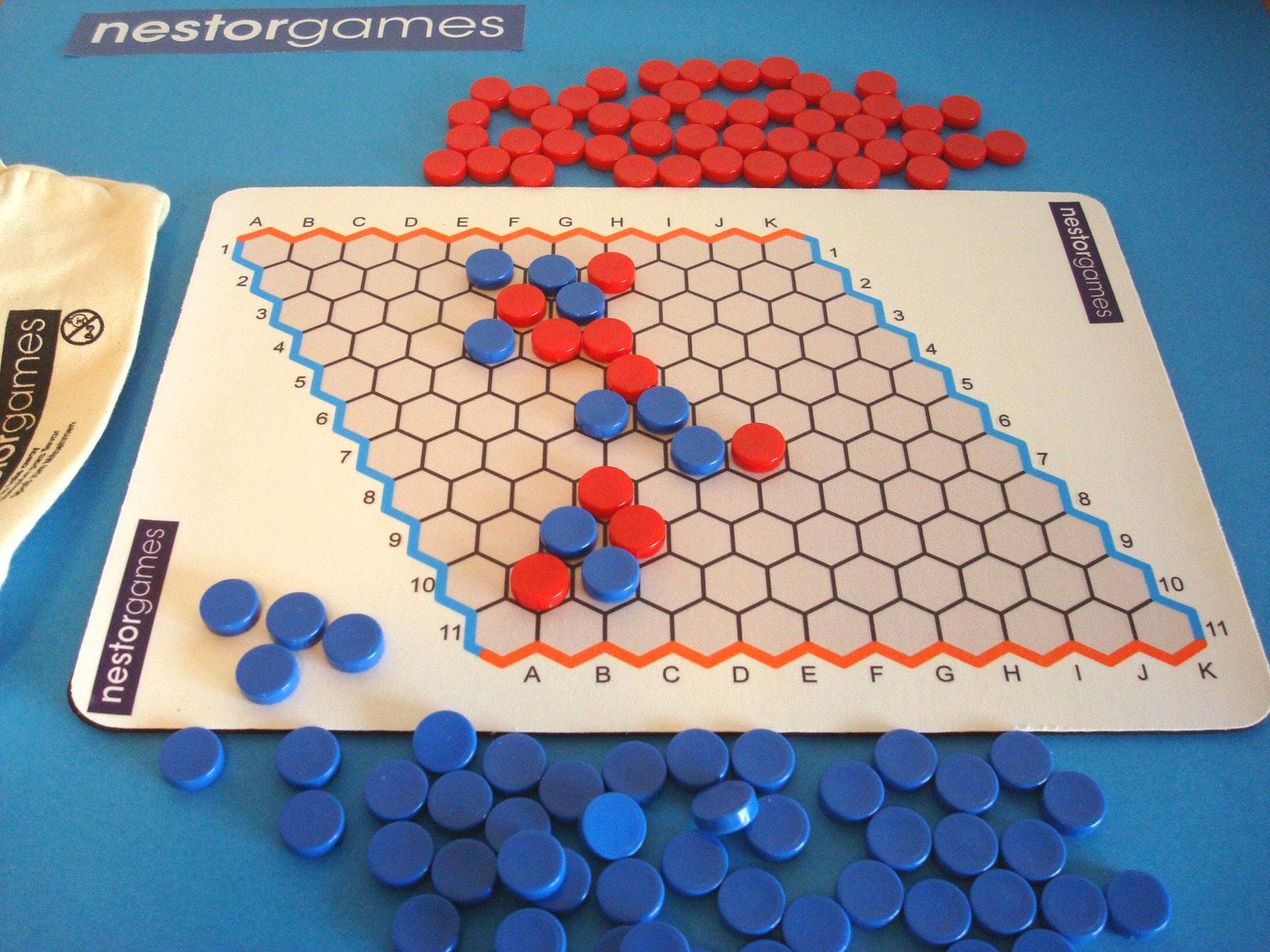
Piet Hein’s (and John Nash’s) Hex is simplicity itself. Make a connection between your two sides. There can’t be a draw … if you’ve totally blocked your opponent you have (by necessity) made a connection between your sides. That’s it.
Hex is sometimes called “Nash” because John Nash “rediscovered it” and introduced it to his local group six-ish years after Hein published it in Denmark3. Nash claims he discovered it independently, which may well be true … both men were mathematicians; there is a beautifully simplicity that probably inspired them. Hex is simple enough to seem obvious, but deep enough that proving perfect play is quite difficult, which would obviously be catnip to both men. Hex is still studied by mathematicians (and, later, computer scientists)4.
But Nash may have also seen it played by some Danish mathematicians who were at Princeton, then forgotten about it for years before his “flash of inspiration.”5
Hex inspired a family of games, most famously6 The Game of Y, where each player has to connect three sides of a triangular board. Of course Hex isn’t the first connection game. Gomoku or “Five in a row” is a classic game from the 1700s, and Tic-Tac-Toe is essentially a connection game for children, albeit one that is easily outgrown.
One that is not-so-easily-outgrown is Connect Four.
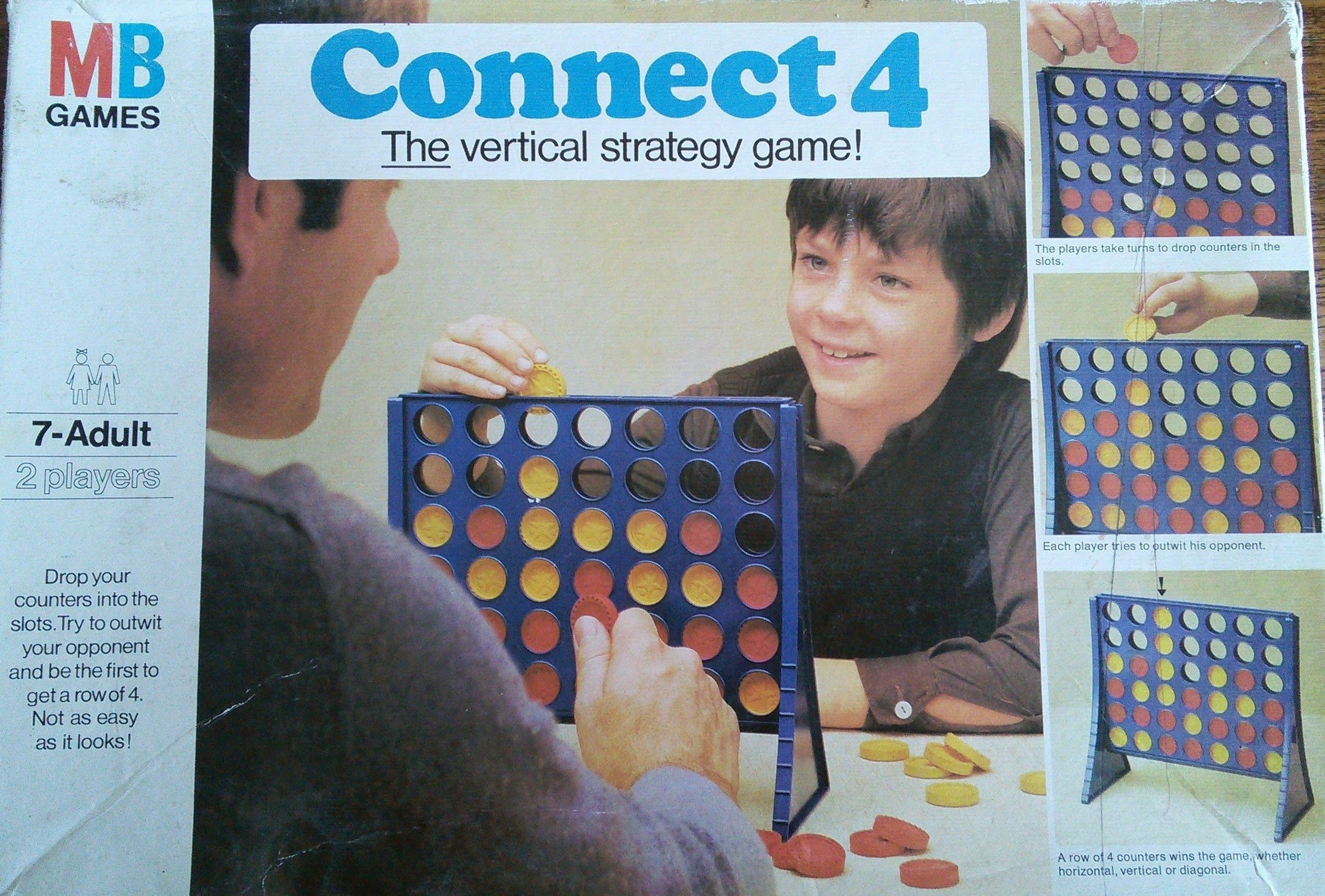
Howard Wexler’s Connect Four is complex enough that it was thought that computers weren’t strong enough to brute force solve it7, which also means that its complicated enough that even adults might have a tough time with it unless they’ve played it often enough. Or you might lose to your sister, in the famous “pretty sneaky, sis” commercial.8 It’s not as complicated as Hex, but perhaps it sits closer to the sweet spot, as it is a much more recognized game.
So … connection games made some advances in the 20th Century, even if they aren’t showing up at your local game night. Whether either (or both?) of these games belongs in The Most Influential Games of the 20th Century is debatable, but both are certainly links between earlier traditional games and the modern board game scene.
And not just during the four years between Olympics. When I was a freshman people kept demanding we change the channel from Olympics to College Sports …. and not even our college.
The local Go Club plays in the game store from time to time.
It’s also sometimes called “John” … because the tiles in the bathrooms were hexagons, so you could play it there.
Hex is “P-Space complete,” a result published in ‘81. And I know just enough computer science theory to know … that’s a big deal, I guess.
Martin Gardner corresponded with Hein, who later agreed this was the most likely explanation. I’ve personally done the same thing. Had a great idea …. only to realize I was simply re-implementing a classic game.
Which admittedly isn’t much, but I’d heard of it and seen a copy prior to researching this article.
Moore’s Law made quick work of that, reminding me of the engineering dictum “If you don’t think Brute Force will work, you simply don’t have enough.”
Thankfully my sister is five years younger than me, so it never came up.