
Modern Art
The Harbinger

Settlers of Catan exploded onto the gaming scene and turned the eyes of American gamers towards Germany (and Europe).1 But portents and signs existed. In ‘92 or ‘93 I went to a major game convention and one game store had a few imports from around the world. One box jumped out at me, and I eventually purchased it.
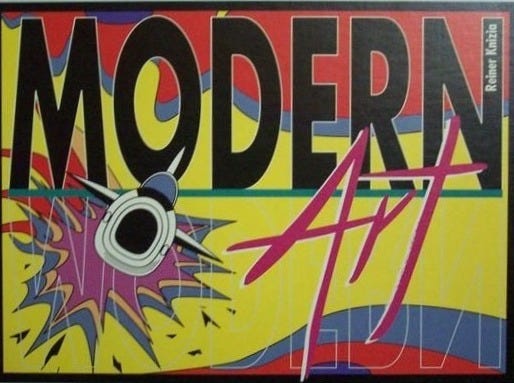
Reiner Knizia’s name will certainly be familiar to my readers.2 While many popular 21st century games seem to have dozens of systems and ways to score (“point-salads”), Knizia’s games are often defined by … not always simplicity, but a focus.
Modern Art sees players selling artworks from their hands, then displaying their purchases to the public. There are a variety of auction types: standard (“shout out your bid”), once around the table, name-your-price, and sealed bids. You make money by selling paintings, to be sure, but paintings you buy go on display in your gallery and will hopefully be sold to the public.
But only the three most popular artists in any round will sell. Should you sell a Karl Gitter on the cheap in order to make your other Gitters more valuable later? Modern Art is about making money; but the auctions disguise the fact that the players are implicitly colluding. If you corner the market by outbidding everyone, you may find the table suddenly selling anything else, hoping to drive their value down. Perhaps its best to let another dealer wet his beak and win an auction, so as to have an ally for later sales….
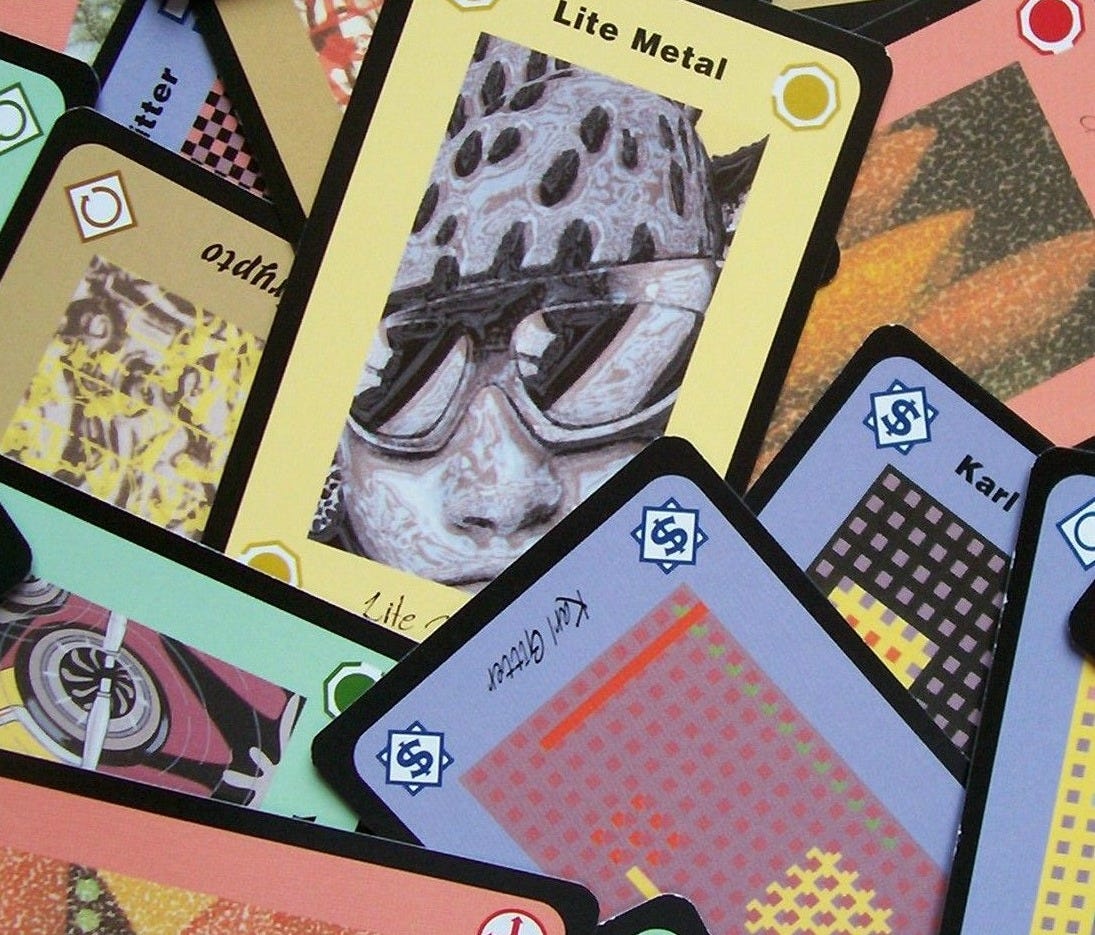
Modern Art is still brought out in every game group I’m in, an impressive feat for a game pushing 40. It also looks great (some editions look better than others).
It never exploded like Settlers did; but Modern Art was a harbinger arriving slightly ahead of it and heralding what was to come. Auction games have always had their place, but Knizia expands it in Modern Art by making players buyer and seller, and making the question not “what is the correct value?” so much as “how can I manipulate the values to my advantage?”
And that question takes a game that has nothing more than 30-45 small auctions and transforms it into a knife fight, with value created and destroyed with every card.
It may be that provincialism is biasing these articles towards Knizia, but he must be on the short list for Best Game developer in my lifetime. The other two entries of Knizia’s “Auction Trilogy” are also worth considering, but Modern Art was the first. Not just one of the first “pure” auction games, but also one of the first to bridge the gap across the Atlantic and introduce gamers to the wider world.
For those reasons, it is a worthy candidate as one of the 100 Most Influential Games of the 20th Century.
Discussed in my article on Settlers of Catan.
This is Doctor Knizia’s third entry into the list, after Tigris and Euphrates and Lord of the Rings.
And one of the clever touches in the original is that the artworks are pastiches of real artists' works.