
Monopoly
The Much Maligned Classic

Is there a game that as popular and influential as Monopoly, yet so hated? Boardgame Geek is showing it’s rating as ‘4.4’1 wildly low for a (nearly) universal kids game. Monopoly is still in print after nearly a century and spawning spinoffs. McDonalds licensed it their giveaways,2 and there are all the variants replacing the famous Atlantic City streets in the original with places from your city, state or counry.3
Monopoly has been in the zeitgeist nearly as long as it’s existed. “Get out of Jail Free” or “Monopoly Money” or “Do Not Pass Go. Do Not Collect $200” aren’t the catchphrases they once were, but you know what they mean.
Monopoly is meme and (almost incidentally) a game.
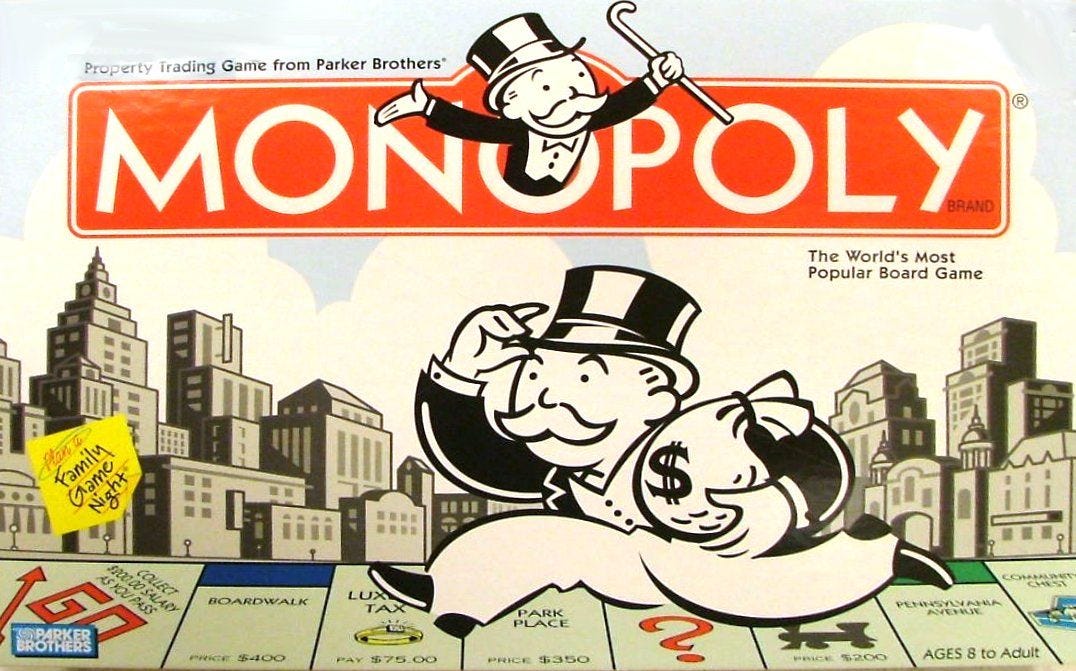
Lizzie Magie and Charles Darrow’s Monopoly is many things, including outright theft. Darrow was credited for years, and it wasn’t until I read Sid Sackson’s Gamut of Games that I discovered that Darrow simply stole it from Magie4, who had published it (and patented it!) as The Landlord’s Game to discuss Georgist Economic Theories.5
Darrow stole Magie’s design, but turned it from an obscure regional board game into a household name around the world, almost erasing her name from history in the process. That would be too “on the nose” if you wrote the story about a game critiquing capitalism; the real world doesn’t care.
Monopoly’s Wikipedia page is practically a novella, and includes notes on the discussions (nay, controversies!) about which tokens would be included in the game. Some words are also devoted to the game, because …
The game is less interesting than it’s history. Monopoly is old-school; and (as a game) “outdated.” There is player elimination, which is brutal for a children’s game. It’s a roll and move with little agency6. Do I buy, or not buy? It’s objectively not a great game.
And that’s before you add in the zillion of homebrew variants, like putting money on Free Parking or removing the auctions! (Did you play with auctions as a kid? Me neither!) It turns out that the Monopoly rules — as printed — make for a better game than most of the rules our older siblings taught us.
No doubt nostalgia is a big reason for Monopoly’s ability to appear on store shelves across the nation. Most people don’t purchase many games, so if they are getting one as a gift (or for their children) they will likely default to a game they have some fond memories of. There are objectively much better games (for adults and kids), but Monopoly endures. I love the Settlers of Catan, but I’ve never heard a comedian reference it.
So Monopoly boldly stakes its claim as being arguably The Most Influential Game of the 20th Century not solely (or even primarily) on game play, but on capturing that lightning in a bottle.
And then selling the bottle, for a nice profit.
Update — Fixed Lizzie Magie’s name, as per the comment below.
5 being “mediocre” and 4 “not so good, but could play again.” Say what you want about the BGG rating system, nearly all of the games featured on this site (or that need to be written) are rated much higher.
I found a Russian version of Monopoly in game store in Pittsburgh. Amusingly (to me) it was produced in Ireland.
This knowledge has become more widespread in the last few years.
Henry George was kind of a big deal in the late 1800s, and the idea of making a book or game or movie to push economics was also en vogue (The most famous example being The Wizard of Oz).
You can make games with Player Elimination and Roll and Move that are good, but it’s not as easy as it sounds.
We played with auctions when I was younger once someone read the rules. Unlike Joe, I've never seen a game of Monopoly go in less than an hour. I can see that happening only if everyone is really familiar with the game and is playing rally fast. (Of course, if Joe is Joe Huber, the speed of games he plays in is legendary.) Typical play time for us has been right around two hours.
I agree with Joe that at its heart, Monopoly is really a trading game. Purchasing the properties serves the same purpose as the minor company distribution in 18xx--it gives everyone a varied position from which to start. However, the manner in which this is done typically leads to widely varying holding values based purely on chance and takes a long time to complete. Just like some 18xx, the game can be won and lost in this phase.
As a trading game, if no one at the table is willing to trade, and no one has a natural property set, the game is going to really drag. There's not really an in game mechanism to force the game to completion, at least not quickly. The game is also going to drag if people are trading, but no one is pushing the game to the end by extracting money from their opponents.
Unfortunately, the roll and move aspects of the game can hinder everything. You can be stuck with virtually no property, so you're not really involved in the trading aspect. And a great setup in property and developments can still be undone by die rolls that favor another. Who wants to spend two plus hours doing that?
Believe "Magie" is typo'ed?
Titan would be a successful game with roll-and-move and player elimination, though probably still best as a two-player game.