
Mouse Trap
A dancing ... mouse

The thing about dancing bears: The bear sways. Possibly in time. That is it.
Bears do not (as a rule) tap dance or perform highly complicated dances. Adjust your expectations accordingly. I am sometimes bemused to see people rating children’s games (on BGG) as boring. Yes, you are no longer a child. I’m sure my grandmother was not terribly interested when playing card games with her grandchildren (to surreptitiously teach us math). Or at least, not in the game.
Which brings us to Mouse Trap.
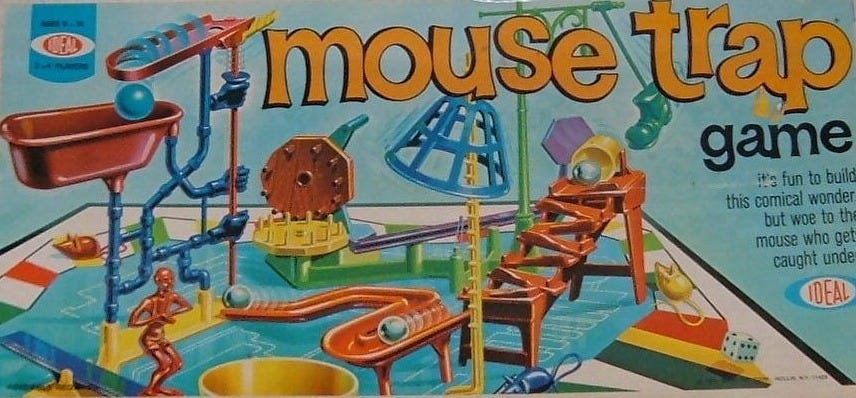
Marvin Glass and Gordon Barlow’s Mouse Trap presumably has rules. I mean, I played it as a kid. But who remembers the rules? You remember watching the Rube Goldberg-esque device trap (or more likely, not trap) a cute scurrying playing piece. The image above says it all … a metal ball hitting a stick which knocks another ball into a bathtup and then drops through a whole onto a see-saw launching a diver …. etc.
It’s a delight. Don’t ruin things analyzing the underlying game. In a way, Mouse Trap inspired the zero-eth draft of my Master’s Thesis (“I built it, it worked.”)1 But imagine my surprise on discovering that the 1975 version of the game (pictured above) had the game part revised and updated by none other than Sid Sackson, designer of Acquire! I still don’t remember the rules, but it’s nice that someone at least cared enough to try to make Mouse Trap an actual game, and not just a device.
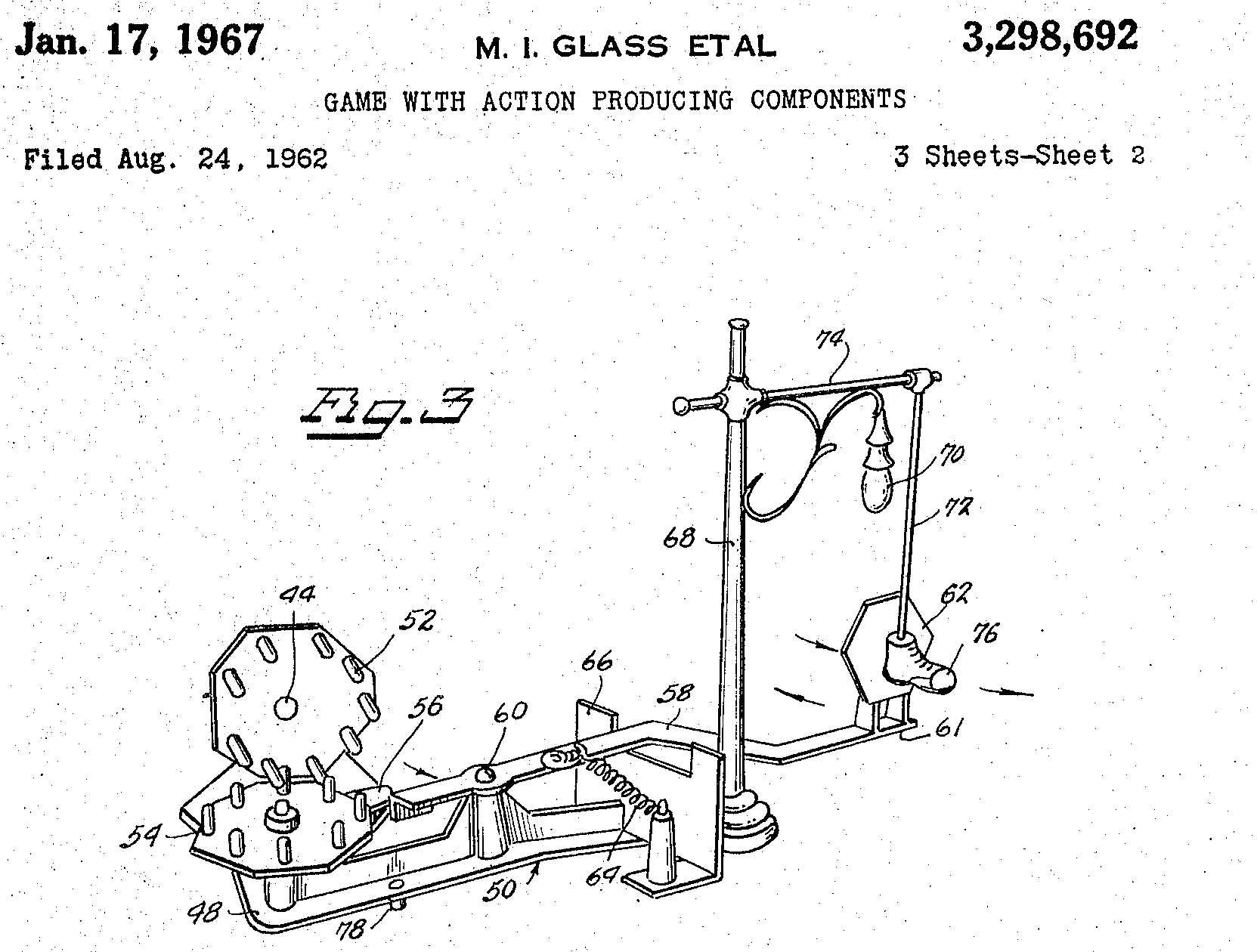
Mouse Trap is iconic not only for the contraption, but also for being a big step in the transition to using plastics in games. It didn’t get there first2, but represented an audacious leap in manufacturing. Frankly, we should all be impressed that Mouse Trap’s Mouse Trap ever worked: cheap plastic, assembled by tiny hands, held together with rubber bands. That bear had some moves, after all.
Back in the 21st century, one frequent discussion on game forums are “over produced” games. Kick starter monstrosities that come in boxes that require lifting instructions, each piece molded plastic, beautifully sculpted and painted. Some rail against this, wondering where the game is, and if it would sell if it were just wooden cubes.3 Others long for the spectacle.
Mouse Trap reminds us that this isn’t a new debate. Is it a great game? I don’t think it really matters: Mouse Trap is certainly worthy of consideration for inclusion in the Most Influential Games of the 20th Century.
Note — The author wishes to acknowledge Amabel Holland of Hollandspiele. Her video essays made me smack my head and add a game (or two or three) to my list of “articles to write,” including this one.
I was encouraged to a) elaborate and b) make it sound more impressive.
Cootie (and Mr. Potato Head) were both in ‘49. Mouse Trap was published in 1967.
I would mention “cardboard chits” but am not able to provide the requisite fainting couch.