
Titan
Solving "Let's You and Him Fight"

Every now and then I see things like “Chess for four players.” There’s a real problem with that …. if you are playing real chess and trade bishops, it’s an even game. If you are playing four player chess and you trade bishops with opponent A, then B and C are now one bishop ahead of you. That’s bad, the other players are ahead.
But maybe that means that now everyone will attack B and C. “Gang up on the leader,” will be the rallying cry. This is the Petty Diplomacy Problem1, often referred to as “Crabs in a bucket,” where nobody can escape because the leader keeps getting pulled back.
It’s hard to design a good game where three or more players duke it out.
But not impossible.
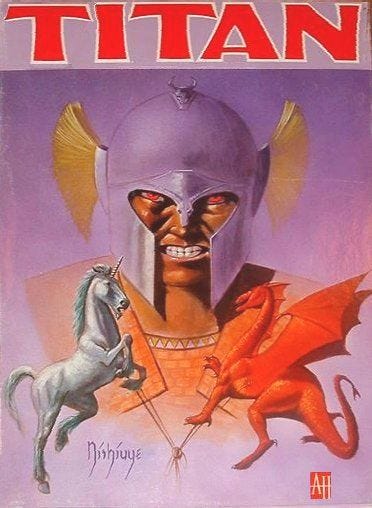
Jason McAllister and David Trampier’s Titan is a theme that games love. Recruit Monsters to bash in the other guy. Like Chess, you lose when your King (your “Titan”) is killed. But not to worry, he’s got an entourage. Starting with small, puny creatures like centaurs or gargoyles or ogres, you move around the main board. Certain spaces let you recruit better creatures with the weaker ones, until you have unicorns, dragons, serpents, etc. You start with two face-down stacks of creatures (one with your Titan) and can make them stronger and also split them apart (to create space and also disguise where your Titan is).
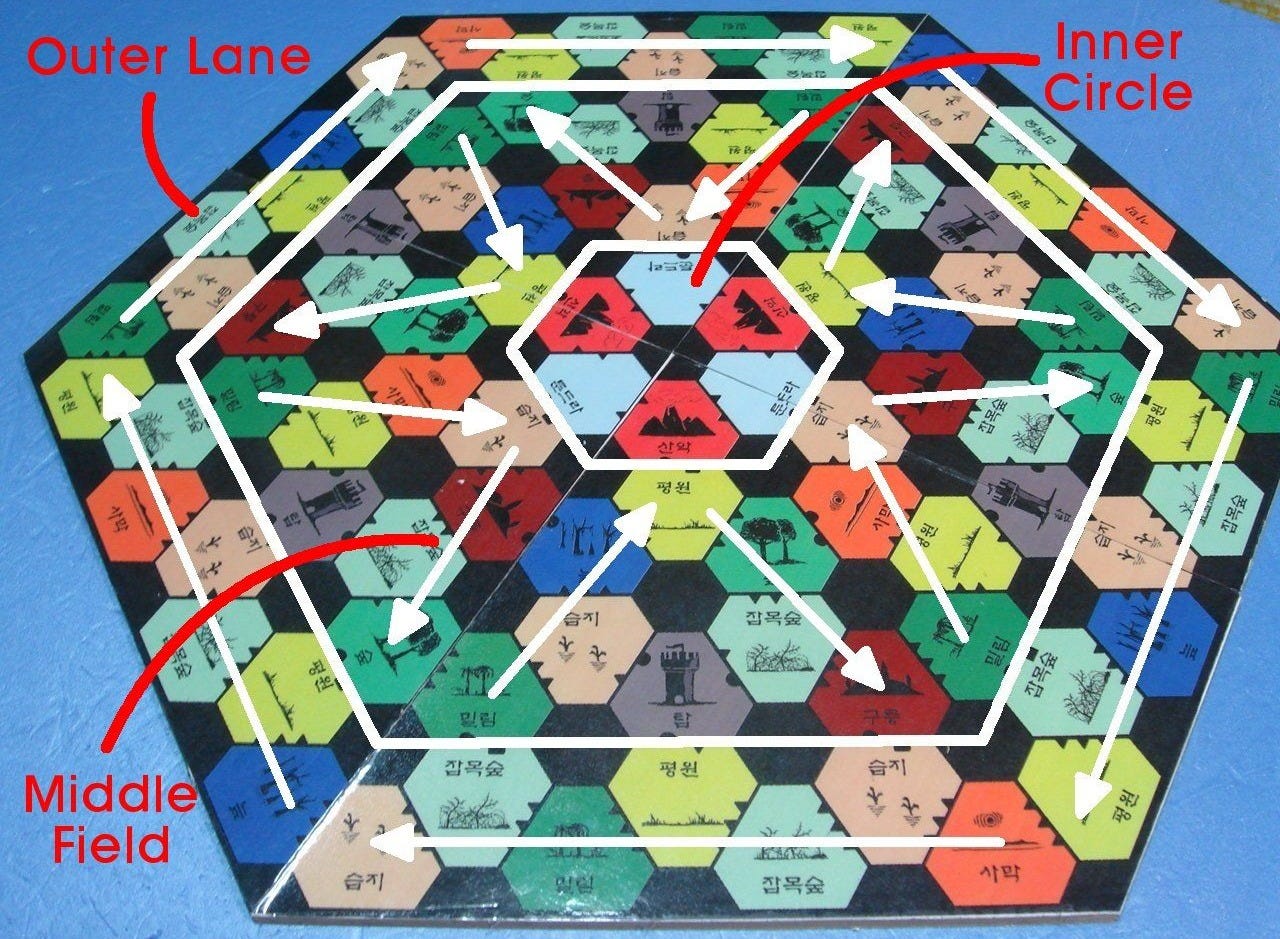
How does Titan deal with the multiplayer issue? A few ways. First … movement on the board is tightly constrained. You can’t just go where you want. How far you can move is random, and the direction is controlled. You might get 2-3 choices, but sometimes only one.
More importantly, when two players fight in Titan, there’s no guarantee that they both will become weaker. That could happen, but one might become stronger … winning a battle provides a chance to recruit and might summon an Angel — a powerful piece that can fly from battle to battle. Also, as you win more battles, your Titan grows in strength, making it harder to kill (and better placed to murder those in its way).
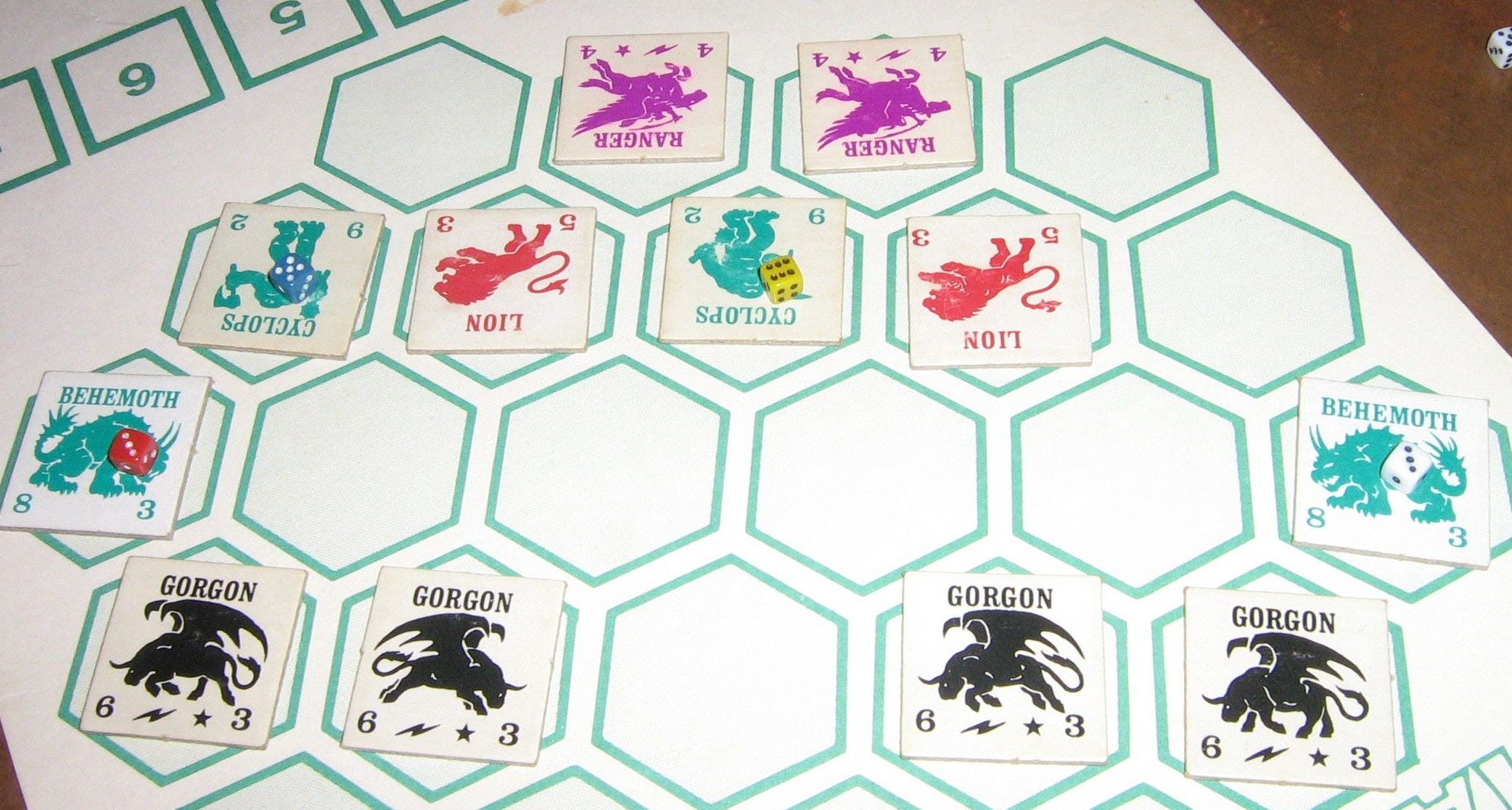
Titan’s battles are dice chucking fests, but with a strategy of their own2.
Almost fifty years later games keep getting published that have the problems that Titan solved. Which is not to say Titan is perfect. Titan is (somewhat famously) considered to be a slow, plodding game. My first game exemplifies this. It started around 10pm and ended around 6am3. Thankfully for me, I was eliminated around 2am, so I went home then. (But most people consider player elimination a ‘bad’ mechanism).
As you learn the game, it picks up speed considerably. I’ve played games in under an hour, and one of my more recent games was 20 minutes (when two stacks containing Titans fight, at least one player is leaving soon). Another flaw is that when two players are fighting, the other players … watch them fight.4 And battles can take 10-20 minutes. So while Titan can play six players, I prefer four or less.
Is Titan one of the Most Influential Games of the 20th Century? Hmmmm….
“Summon monsters to murder your opponents” pops up all over the place in games and fiction; Titan is a relatively early example but hardly the first. Did Titan inspire Magic, or Heroes of Might and Magic, or Archon, or Mage Wars or …. any of the games that share its theme, or was it just the zeitgeist? I don’t know.
People (like me!) point to it as a game that (mostly) solves the “every man for himself fighting game”, but often because so few games manage to get that right. Titan seems rightly placed as an entry on “Tentative Tuesday.” Great game, influence is borderline. Titan succeeds where others have failed, but that doesn’t seem to have garnered it the a huge following.
Not to be confused with the See Kory Heath’s article on design problems.
When I was in graduate school one undergrad was trying to write a computer program to play battles accurately. I have no idea how it turned out, but he was coming by the game club to ask players for advice.
Avalon Hill called Titan a “Fantasy Monster Slug-a-thon” for a reason.
It's funny too that Dr. Knizia has a design in the Titan "line", though it's very different from any of his designs.
It just might be that it's had more influence on computer games that it has on board games.