
Whiffle
Or perhaps Baffleball, Ballyhoo, Humpty Dumpty, or Contact?

Bocce, Croquet, Golf have a simple theme — Throw (or strike) the ball for accuracy, not just for distance. At some point those games inspired tabletop games: Billiards, Snooker, and the like.
But most of those games predate the 20th Century, and date back much earlier than I imagined.
But a modern pinball machine dates back to the 1930s, give or take. Depending on who you ask.
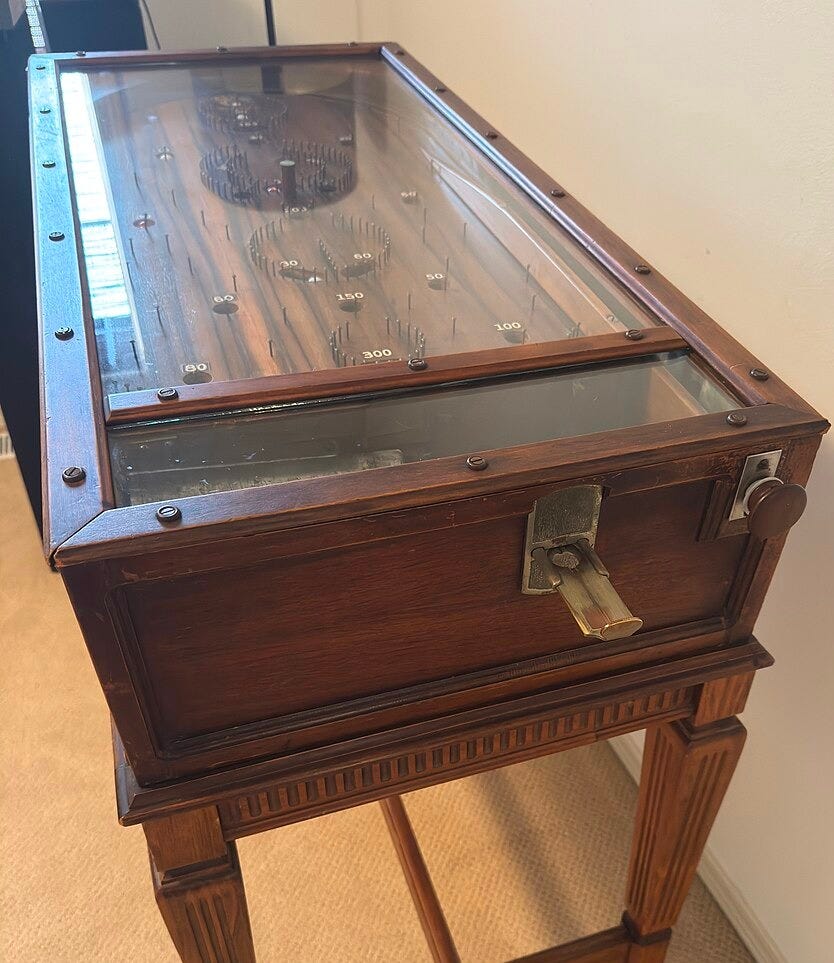

Arthur L. Paulin and Earl W. Froom’s Whiffle is considered the first modern pinball machine by the Internet Pinball Machine Database, and I am in no position to argue against them.
It does have the most important factor of a pinball machine. A slot for the coin. Fifty-ish years before arcades sprung up in malls, an arcade was a place where you’d pay to play games but with an actual operator. Whiffle dispensed with this. But it is hard to recognize it as a modern pinball game. It doesn’t predate electricity, but doesn’t actually use it, either. No bumpers, no flippers. Technically it might actually be more of a Bagatelle1
Whiffle was a big hit, and at it’s peak employed ~70 people making them. Carpenters, woodworkers, and the like. But that very success sparked the “Pinball Patent Wars” … and operator wars, with ”distributors often destroying their competitors machines and replacing them with their own”. Some competitors were content with making copies that looked nearly identical to Whiffle.
But others were not.
.jpg)
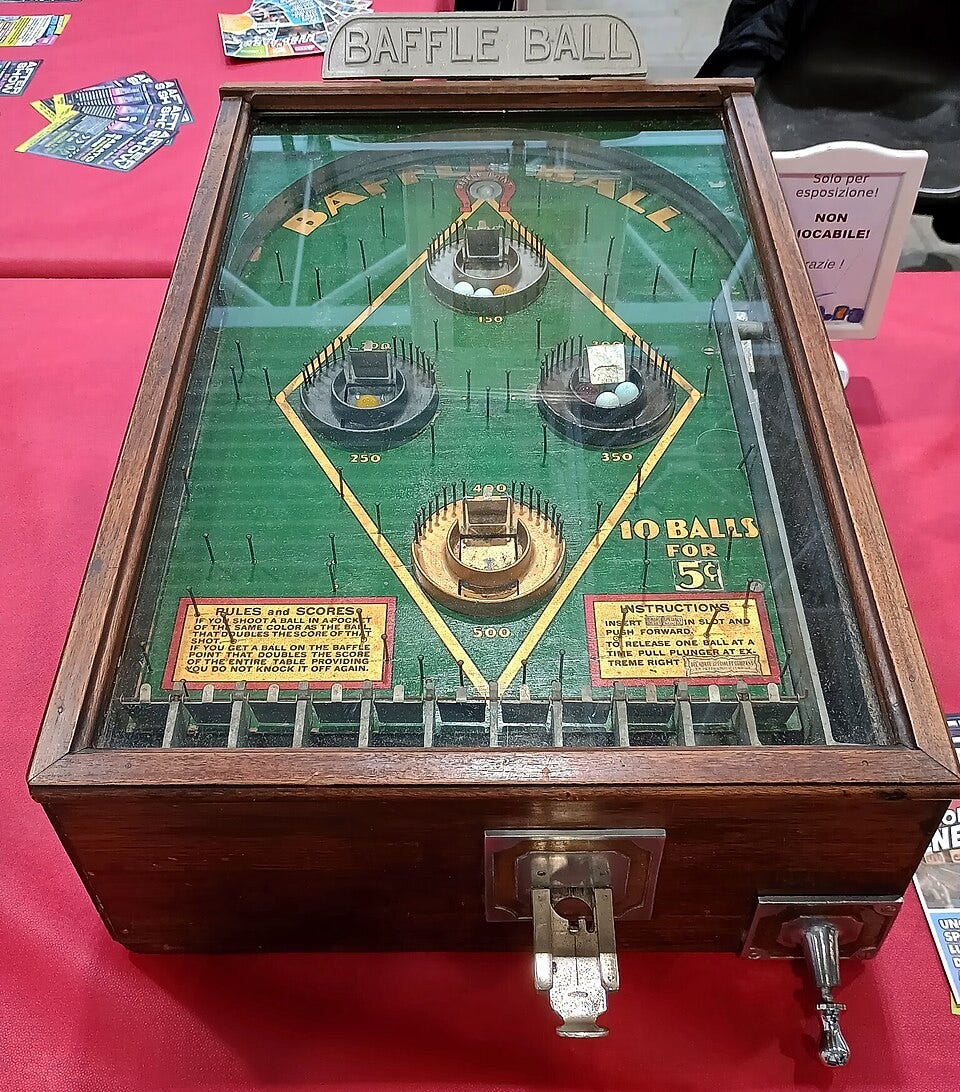
David Gottlieb’s Baffle Ball was (like Whiffle) made in 1931 and may have been a case of convergent evolution … he’d already made a machine called Bingo2 and this was his latest. Despite appearances, it has no real connection to baseball. Again, like Whiffle, there were no flippers, no electricity, and you had to score by hand. (Presumably the crowd of spectators might help).
Gottlieb’s game was more successful than Whiffle … it looks much more inviting and (despite the wood working) had a much more “assembly line” manufacturing process 3. His company4 could produce four hundred a day, at roughly 1/8th the cost of Whiffle ($12.50 instead of $100 ish). With these numbers, Gottlieb sold the machines outright instead of leasing them. He couldn’t keep up with demand, but eventually sold about 50,000 units.
And because he couldn’t keep up with demand, more companies opened … many more. The two models discussed were released in ‘31; by the end of ‘32 there were roughly 150 pinball companies!
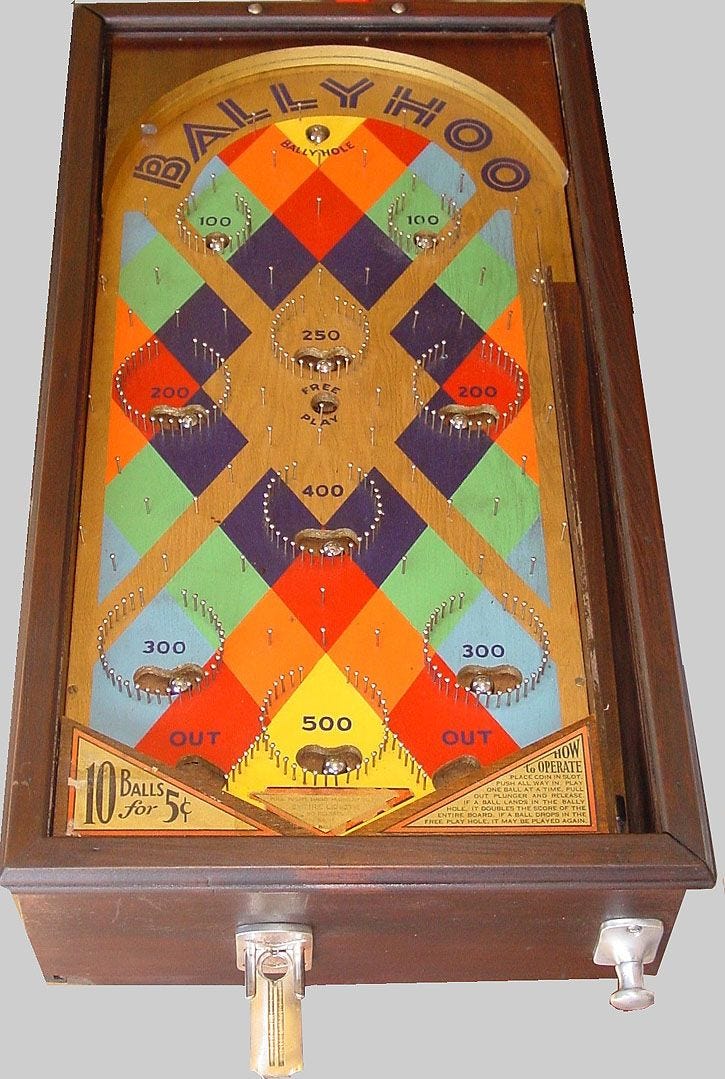
Raymond Moloney was working as a distributor for Gottlieb, and his first game Ballyhoo later shortened to become the company name — Bally Manufacturing. Ballyhoo is starting to look more like a pinball game, with the sloping sides down to a chute. But even though your eyes want to put them there, mechanical flippers wouldn’t be invented (by Gottlieb) until 1947’s Humpty Dumpty.5 (The delay was partially caused by most manufacturing being converted to the war effort).
Electric bumpers (and ringing noises) were introduced in 1933 by Harry Williams Contact6 and quickly got adopted by the rest of the industry. The bright noises (and later lights) signaled the death knell for Whiffle.
And of course the evolution continued unabated, up to the beloved Twilight Zone, Star Trek:TNG, and Adamms Family machines that graced my graduate schools arcade and graciously accepted my quarters. And while they have become more niche with arcade games (and home consoles), there are still glorious retro arcades and individual owners carefully maintaining and playing them. (Just look at the IPDB!)
So … some early pinball machine should be on the 100 Most Influential Games of The 20th Century, possibly more than one. But which one? At this point I am going to throw up my hands and defer to the IPDB, and call it Whiffle.
Should there be more? Is my history wrong? (It could easily be). But even just the minimal research for this article showed me multiple enticing rabbit holes that I decided not to fall into7.
Perhaps more knowing Pinball afficionados can comment below.
“Get the marble in the hole, dodging obstacles and maybe avoid knocking down pins.” And no, I didn’t know that had a formal name until researching this article.
Which makes it hard to research, Wikipedia simply notes it without a link to anything but a few newsletters from the 30s.
Froom said his machine had “real cabinetry” as compared to cheap silk screening and gaudy lights of later machines.
Gottlieb & co, established 1927.
And the “dual inward facing flippers” that we are used to didn’t show up until 1950’s Just 21.
And the Williams went on to found his own company, Williams Manufacturing.
I am not a board game historian by any means, but neither am I almost wholly ignorant of the field, unlike Pinball.
In the 30s-50s they were closely tied to organized crime, being widely used as illegal gambling devices, which must have been a big part of the appeal.