
Dune
Through the sands of time

With the recent Denis Villeneuve adaptation, Dune is back in the public consciousness. It keeps popping up, re-interpreted every generation or so. And with the movie came a slate of board games. But the first board game to bear the name predates the movies (even the Lynch version) and remains the gold standard. (Spice standard?)
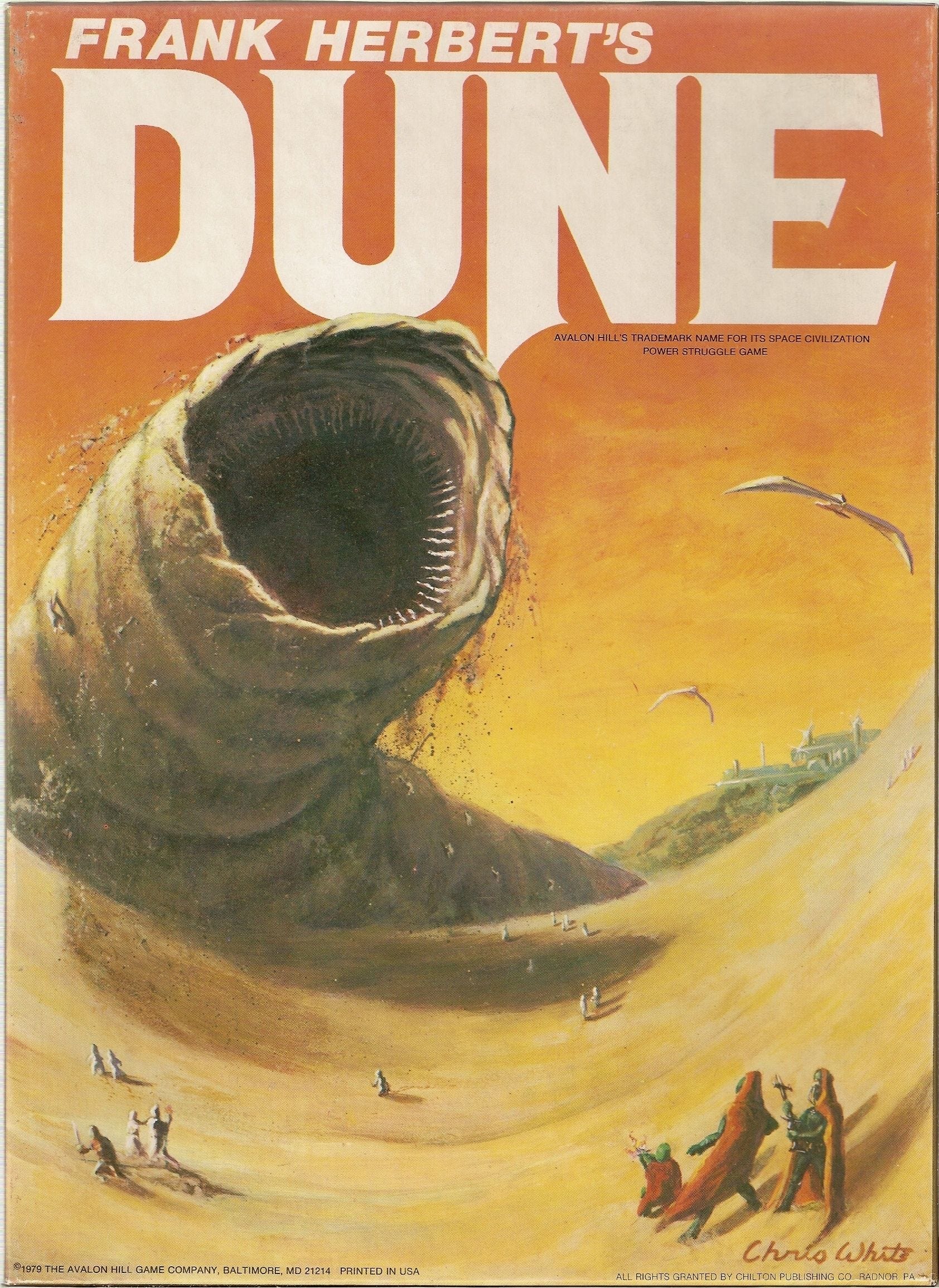
Bill Eberle, Jack Kittredge, Peter Olotka’s Dune is a game with a pedigree. Not only is it based on one of the classic books of the 20th century, but the designers had already worked (along with Bill Norton) on Cosmic Encounter, a first ballot entry in this project.
They had been working on a game of intrigue and conquest set in Rome, but Avalon Hill had acquired the rights to make a Dune game and eventually came calling after their designs stagnated. Like many of the games they designed, Dune’s execution seems novel, yet inevitable. Combat is based on how many troops you have available, but each player can secretly (and simultaneously) commit troops for an advantage. But all committed troops die, so there’s a cost.
Additionally, each player must assign a leader in combat (who are usually worth multiple troops1). But each player secretly controls one traitor from another faction2, and if you send your traitor against his or her handler … the battle is lost.
At its heart, Dune could be compared to other “Dudes on a map” game where you try to maneuver, battle, and grab key territories (in this case, ‘strongholds’). If a player controls enough strongholds, he wins. Two factions can ally for a joint victory. There are also some cards (‘treachery cards’) that can add to battles or let you mess with other players. So far, so standard (apart from the combat).
But … each faction has special abilities; Dune captures the feel and lore of Herbert’s Book(s). House Atreides has precognition and can peek at ‘treachery’ cards before bidding on them (and keep notes as to who bought what). The emperor is rich and well-armed, the Harkonnen’s control more traitors and get bonus treachery cards. The spacing guild gets paid to move troops and the Fremen can move through the desert safely and easily.
And the Bene Gesserit can — to put it politely — mess with your mind.
The Bene Gesserit can choose to coexist and move with you, safe and inviolate advisors. Or they can betray you and fight (their choice, not yours). During combat they can force you to play cards (or prevent you from playing cards). And in one of the most thematic rules in gaming, at the start of the game they predict the winner (both player and turn number) and if their prediction is correct … the Bene Gesserit have fulfilled their prophecy and win instead.
You can never trust the witches, even when they are helping you.
Many other thematic elements will resonate with those who’ve read the books or seen the movies. That, coupled with the faction-specific rules, brings the world feels alive. And unlike Risk and other games, Dune has a decidedly fixed number of turns. If the game has not ended by the 10th turn, then either the Fremen or Spacing Guild will win, based on board state. This is not a long-drawn out affair but a knife fight3. Dune isn’t fast, negotiations for alliances take time4, but it ends.
Battles have no dice, only tension. “How many troops must I sacrifice to win?” “Can I get away with a few less so as to keep a reserve?” “What weapons will he use against my leader?” And even a numerical ‘safe’ battle is risky due to traitors.
Dune was recognized as a good game on release, but after the Lynch movie it became something of a grail game, with collectors snapping up copies. With the latest movies, Dune has been re-released5 and is being re-discovered. As the design moves inexorably towards its 50th anniversary, it is still hitting the table and surprising people (myself included) with depths not suggested by a relatively simple set of rules.
Dune exists in a sort of timeless state, where it’s rules were unusual when it was published and still unusual now, but it works. Despite languishing in semi-obscurity for three decades, Dune has been reborn. I believe it is ready to claim it’s spot in the Most Influential Games of the 20th Century.
What do you think?
Think of Paul Atreides or Chani or Duncan Idaho from the movie. Or Feyd-Rautha for that matter. They get a lot more screen time for a reason.
In the books and movies, the Harkonnen’s secretly control House Atreides’ Doctor Yueh.
The slow knife penetrates the shield.
And recriminations, and glances at the Bene Gesserit …
There was a 2012 game (Rex: The Final Days of an Empire) that kept the gameplay but did not have a license to use the Dune theme.
Much as I enjoyed Dune back in the day, I always felt it was a Cosmic Encounter variant. A fixed set of powers every game rather than a different, random selection. However, the tie-in with the novel gives it bags of atmosphere, as you show.